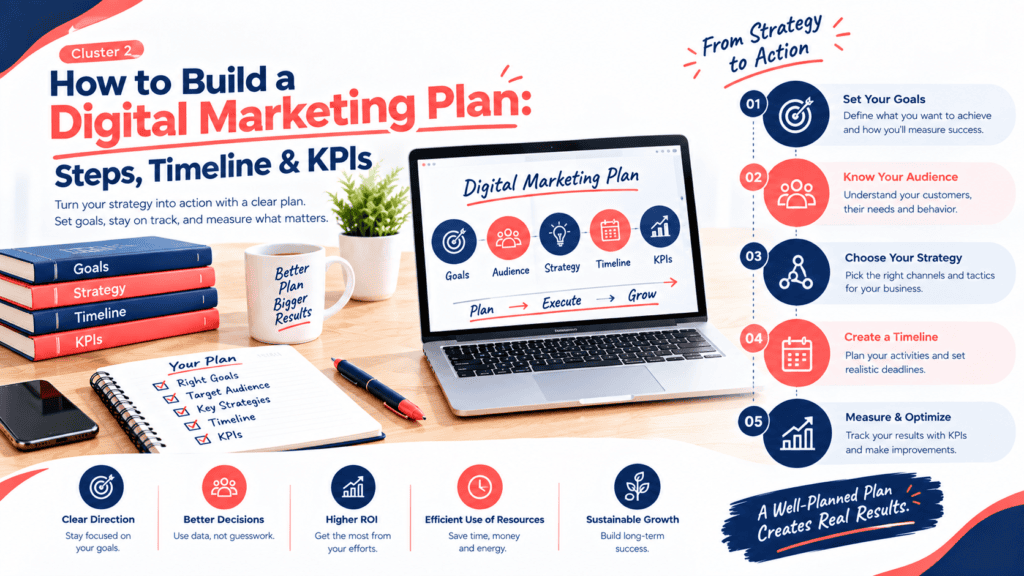
A successful digital marketing strategy gives your business direction, but a digital marketing plan turns that strategy into clear and achievable actions. It helps you decide what needs to be done, when it should be done, who you want to reach, and how you will measure progress.
Without a structured plan, businesses may spend time creating content, running campaigns, or using different digital channels without knowing whether those activities are actually contributing to their goals.
A well-developed digital marketing plan creates a roadmap that connects your business goals, target audience, content, marketing activities, timeline, and performance measurement.
In this guide, you’ll learn how to build a digital marketing plan step by step, create a realistic timeline, choose the right KPIs, and continuously improve your plan based on results.
Having a digital marketing strategy gives your business direction, but direction alone isn’t enough. You also need a clear plan that explains what needs to be done, when it should be done, who is responsible, and how success will be measured.
A digital marketing plan turns your broader strategy into practical actions. It helps you organize your marketing activities, prioritize tasks, allocate resources, create timelines, and track performance.
Whether you’re a small business, startup, freelancer, or established company, a structured digital marketing plan can help you stay focused and make your online marketing efforts more consistent.
If you haven’t developed your overall strategy yet, start with our guide to [Digital Marketing Strategy for Business Growth].
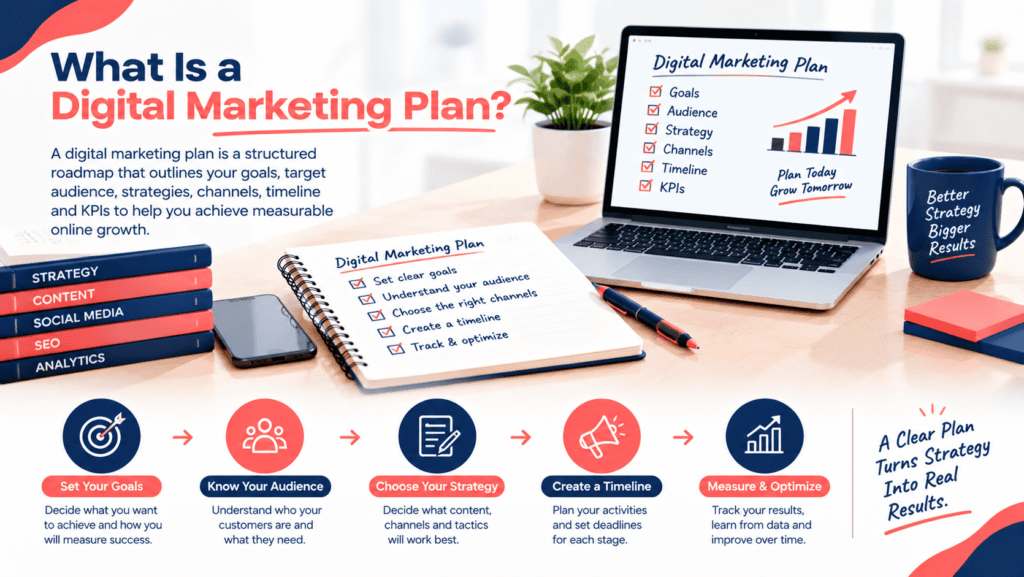
A digital marketing plan is a practical roadmap that outlines the specific marketing activities a business will implement to achieve its goals.
While a strategy establishes the overall direction, a digital marketing plan focuses on execution.
A digital marketing plan typically includes:
In simple terms:
Strategy tells you where you want to go. A plan explains how you’re going to get there.
It’s important to understand the difference between the two.
| Digital Marketing Strategy | Digital Marketing Plan |
|---|---|
| Defines overall direction | Defines specific actions |
| Explains what and why | Explains how and when |
| Focuses on long-term direction | Focuses on execution |
| Identifies priorities | Organizes tasks |
| Defines the approach | Creates timelines |
| Establishes strategic goals | Tracks KPIs and results |
For example:
Your strategy might be:
Build organic visibility and attract qualified customers through useful online content.
Your plan might be:
Publish two educational articles per month, optimize existing pages, monitor organic traffic, and review lead generation every month.
That’s the difference between having a direction and having a practical roadmap.
Before creating individual tasks, decide what you want your digital marketing efforts to achieve.
Your goals should connect directly to your business objectives.
Common digital marketing goals include:
Instead of creating vague goals such as:
“Get more customers.”
make them more specific.
For example:
“Increase qualified website leads over the next six months.”
Clear goals make it easier to determine which activities belong in your marketing plan
Your marketing plan should clearly identify who you’re trying to reach.
Use your audience research to define:
This information will influence your content, messaging, marketing channels, and campaigns.
Your marketing activities should be built around your audience rather than simply around what your business wants to promote.

You don’t need to use every digital marketing channel available.
Choose channels based on:
Depending on your business, your plan could include channels such as:
The important thing is to choose channels strategically.
For example, if your audience frequently searches for solutions online, building useful search-focused content may be an important part of your plan.
Content is often an important part of a digital marketing plan.
Instead of deciding what to publish at the last minute, create a content schedule.
Your content plan could include:
Blog posts
Educational articles that answer customer questions.
Website content
Pages that explain your business, products, services, or solutions.
Social media content
Posts designed to educate, engage, or build awareness.
Visual content
Infographics, graphics, videos, and other visual formats.
Supporting content
FAQs, guides, checklists, case studies, and other useful resources.
Your content should support your goals and customer journey.
A content calendar turns your content ideas into scheduled activities.
For example:
| Week | Content Activity | Goal |
|---|---|---|
| Week 1 | Educational blog | Awareness |
| Week 2 | Social media content | Engagement |
| Week 3 | Blog/guide | Consideration |
| Week 4 | Conversion-focused content | Leads |
You can expand this into a monthly or quarterly calendar.
A content calendar helps you:
A marketing plan becomes more effective when everyone knows what needs to be done.
For each activity, identify:
What needs to be done?
Who will do it?
When should it be completed?
What resources are required?
For example:
| Activity | Responsibility | Frequency |
|---|---|---|
| Blog research | Content creator | Monthly |
| Blog publishing | Website manager | Monthly |
| Social content | Marketing team | Weekly |
| Performance tracking | Marketing manager | Monthly |
If you’re managing your marketing yourself, you can still use this structure to organize your own workload.
A timeline turns your plan into a sequence of activities.
You can organize your marketing plan into:
30-Day plan
Focus on preparation and foundational activities.
60-Day plan
Begin implementing your marketing activities.
90- Day plan
Evaluate performance and make improvements.
The exact timeline will depend on your business, resources, and objectives.
Your digital marketing plan should account for the resources available to you.
Your budget may include:
You don’t need to spend heavily from the beginning.
Start by identifying which activities are most closely connected to your goals and allocate resources accordingly.
Then measure the results and adjust your investment based on performance.
A digital marketing plan needs measurable indicators.
These are called Key Performance Indicators (KPIs).
Your KPIs should reflect your actual business objectives.
If your goal is visbility:
Track:
If your goal is lead generation:
Track:
If your goal is sales:
Track:
Don’t measure everything simply because you can.
Choose KPIs that help you understand whether your marketing plan is moving your business toward its goals.
Once your plan is running, regularly review your performance.
Ask:
This turns your marketing plan into a continuous improvement process.
Your first plan doesn’t have to be perfect.
Digital marketing works best when you continually learn from your results.
Use this cycle:
Plan → Execute → Measure → Analyze → Improve
For example:
If one type of content consistently generates qualified traffic, you may decide to create more content around similar topics.
If an activity isn’t producing meaningful results, you can investigate why and decide whether to improve, change, or reduce it.
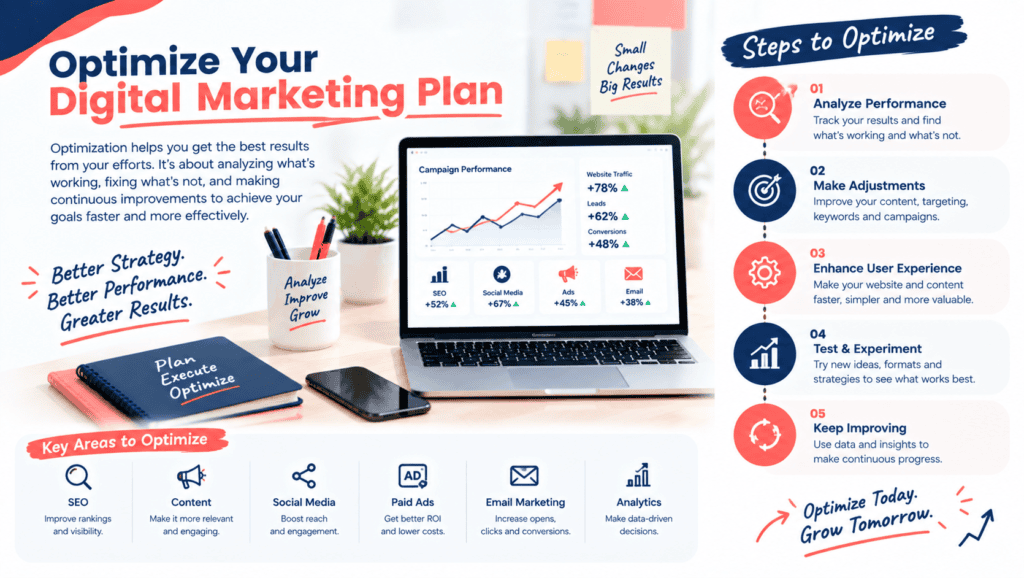
In Digital marketing plan competitor research is an important part of creating a successful digital marketing plan. Before investing your time and budget in different marketing activities, understand what your competitors are doing online and where there may be opportunities for your business.
Start by identifying your main competitors. Review their websites, social media profiles, blog content, search engine visibility, advertisements, offers, and customer reviews. Pay attention to the topics they cover and the type of content that receives engagement from their audience.
Keyword research can also help you understand which search terms your competitors are targeting. Look for keywords that are relevant to your business but are not being covered thoroughly by competitors. These opportunities can help you create more useful and targeted content.
You should also look at your competitors’ strengths and weaknesses. For example, one competitor may have strong social media activity but limited educational content, while another may rank well in search results but have a poor website experience.
The goal of competitor research is not to copy what other businesses are doing. Instead, use the information to identify gaps, understand customer expectations, and find ways to make your digital marketing plan more effective.
Regular competitor research can also help you stay aware of changes in your industry and adapt your marketing activities when necessary.
Keyword research helps you understand what your potential customers are searching for online. It should be an important part of your digital marketing plan because it can guide your website content, blog topics, landing pages, and SEO activities.
Start by creating a list of keywords related to your products, services, industry, and customer problems. You can then organize these keywords based on their relevance and search intent.
Search intent explains what a person is trying to accomplish when they enter a search query. For example, someone searching for “what is digital marketing” is probably looking for information, while someone searching for “digital marketing consultant near me” may be closer to making a decision.
Consider using different types of keywords in your plan, including broad keywords, long-tail keywords, informational keywords, commercial keywords, and location-based keywords when relevant.
For example, a business targeting digital marketing customers might use keywords such as “digital marketing strategy,” “digital marketing plan,” “SEO strategy for business growth,” and “digital marketing consultant.”
Once you identify your important keywords, use them naturally in your content. Avoid repeating the same keyword unnecessarily. Your main goal should be to create useful content that satisfies the searcher’s needs.
Keyword research should also be reviewed periodically because search behavior can change. New topics, customer questions, and industry trends can create additional opportunities for your business.
A digital marketing plan should not focus only on attracting website visitors. It should also explain how those visitors can become leads and customers.
Start by deciding what action you want visitors to take after interacting with your business. Depending on your business model, this could be filling out a contact form, requesting a quote, booking a consultation, signing up for an email newsletter, downloading a resource, or making a purchase.
Create clear calls to action throughout your website and marketing content. Your calls to action should tell visitors what they can do next and explain the value of taking that action.
Landing pages can also support your lead generation strategy. A landing page should focus on one specific offer or objective and provide enough information to help visitors make a decision.
You can also use lead magnets such as guides, checklists, templates, or educational resources to encourage potential customers to provide their contact information.
Once you generate leads, consider how you will follow up with them. Email marketing, useful content, personalized communication, and timely follow-ups can help move potential customers closer to a purchase.
Your conversion strategy should be connected to your overall digital marketing plan. For example, SEO may bring visitors to your website, content may educate them, and a landing page or consultation form may convert them into leads.
By planning the complete journey from visitor to customer, you can make your digital marketing activities more focused on meaningful business results rather than traffic alone.
A successful digital marketing plan should not stop after gaining a new customer. Keeping existing customers engaged can help build long-term relationships and encourage repeat business.
Start by understanding what your existing customers need after making a purchase or using your service. Provide useful information, helpful resources, product updates, educational content, and relevant offers that continue to provide value.
Email marketing can be an effective way to stay connected with existing customers. You can send newsletters, product updates, helpful tips, personalized recommendations, or follow-up messages based on customer behavior.
Social media can also support customer retention by giving customers a place to interact with your brand and receive updates. Responding to questions and comments can help strengthen relationships and demonstrate that your business values its customers.
Customer feedback is another important part of retention. Encourage customers to share reviews, suggestions, and experiences. Their feedback can help you identify areas that need improvement and understand what customers value most.
You can also develop loyalty initiatives, exclusive offers, referral programs, or personalized experiences where appropriate.
Customer retention should be measured as part of your overall digital marketing plan. Look at metrics such as repeat purchases, customer engagement, email interactions, referrals, and customer retention rates.
Focusing on existing customers alongside new customer acquisition can create a more balanced marketing approach. Instead of constantly starting from zero, your business can build a growing audience of customers who already know and trust your brand.
A strong retention strategy therefore helps turn digital marketing from a short-term promotional activity into a long-term process for building customer relationships and sustainable business growth.
Let’s say a small business wants to increase qualified leads.
Their plan could look like this:
Goal
Generate more qualified website leads.
Audience
Small business owners looking for help with their online growth.
Content
Create educational blog articles that answer common customer questions.
Channels
Website, search, and social media.
Timeline
Publish two useful articles each month and promote them consistently.
KPIs
Review
Analyze results at the end of each month and adjust the following month’s activities.
This is what turns a broad marketing strategy into a practical plan.
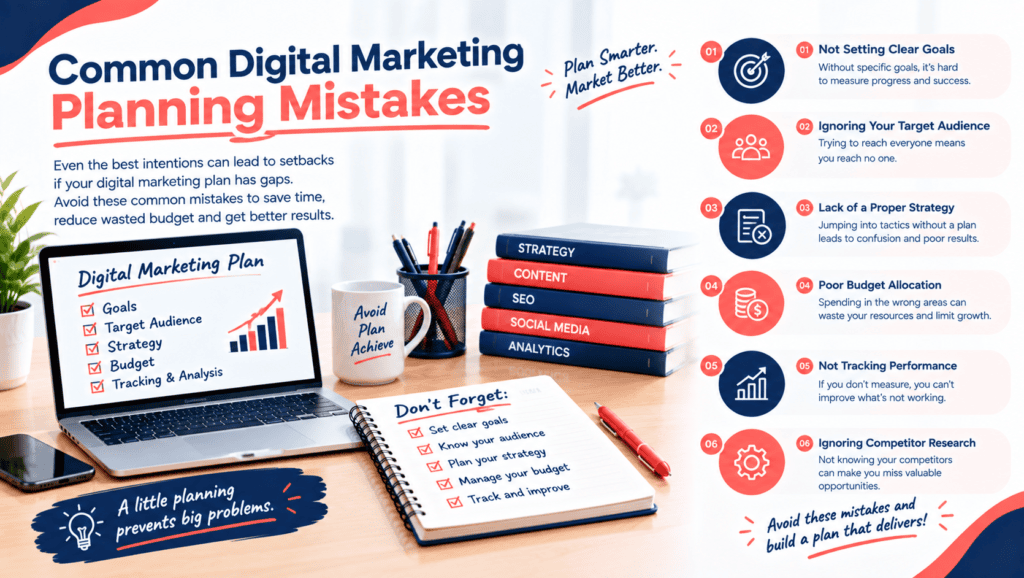
1.Setting too many goals
Trying to achieve everything at once can make your plan difficult to manage.
Focus on the goals that matter most.
2.Choosing too many channels
Being present everywhere isn’t always necessary.
Choose channels that match your audience and objectives.
3.Creating content without a purpose
Every major piece of content should have a reason for being created.
4.Ignoring the timeline
Without deadlines, marketing activities can easily be delayed.
5.Not tracking KPIs
If you don’t measure results, you won’t know whether your plan is working.
6.Never updating the plan
Your marketing plan should evolve based on performance, customer behavior, and business priorities.
There’s no single schedule that works for every business.
A useful approach is:
Weekly:
Check important activities and immediate performance.
Monthly:
Review content, traffic, leads, and campaign performance.
Quarterly:
Review your overall goals, strategy, budget, and priorities.
Regular reviews help you identify what is working and what needs to change.
A digital marketing plan gives your business a practical roadmap for turning marketing goals into measurable actions.
By defining your goals, understanding your audience, choosing the right channels, organizing your content, creating timelines, setting KPIs, and regularly reviewing performance, you can create a more focused and consistent approach to online marketing.
Remember:
Strategy provides the direction. A plan turns that direction into action. Measurement helps you improve it.
Once your plan is in place, continue reviewing your results and making adjustments based on what the data tells you.
© 2026 R Disha. All Right Reserved.
Ready to get started? Chat with us on WhatsApp!