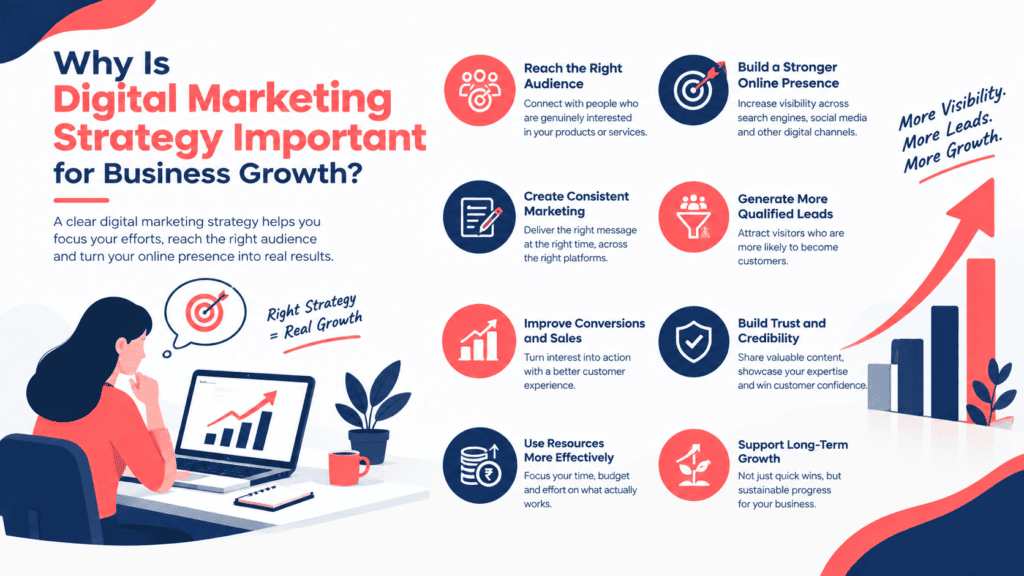
In today’s digital marketplace, having an online presence is no longer enough. Businesses need a clear direction to attract the right audience, build trust, generate customers, and achieve sustainable growth.
A digital marketing strategy for business growth provides that direction. It helps businesses understand their goals, target audience, customer journey, competitors, and marketing priorities before deciding what actions to take.
Instead of trying different marketing activities without a clear purpose, a strategic approach allows businesses to make informed decisions and focus their resources where they can have the greatest impact.
A digital marketing strategy is a structured approach that connects your business goals with your online marketing activities.
It answers important questions such as:
A strategy provides the overall direction for your digital marketing efforts.
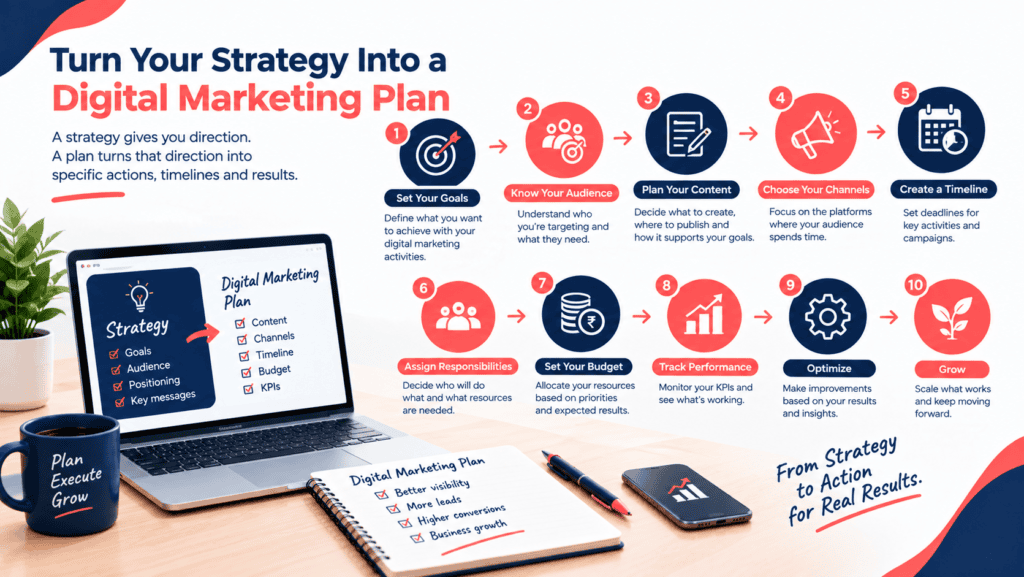
Your digital marketing plan then turns that strategy into specific actions, timelines, and priorities.
Without a clear digital marketing strategy, businesses may spend time and money on different online activities without understanding how those activities contribute to business growth.
A well-defined digital marketing strategy helps you:
The goal isn’t simply to become more visible online.
The goal is to turn online visibility into meaningful business outcomes such as leads, customers, sales, and long-term growth.
Your digital marketing strategy should begin with your business objectives.
Ask yourself:
What do I want my business to achieve?
Your goals could include:
For example, instead of saying:
“I want more website traffic.”
a stronger objective would be:
“I want to attract more qualified visitors who are likely to become customers.”
This gives your digital marketing strategy a clear direction.
The next step is understanding who you want to reach.
Your target audience isn’t simply a group defined by age or location. You should understand their:
For example, if your target audience is small business owners, they may be looking for ways to:
Understanding these needs allows you to create a strategy that focuses on what your customers actually care about.
Customers usually don’t go directly from discovering a business to becoming a customer.
They may move through several stages:
Awareness → Consideration → Decision → Conversion → Retention
At the awareness stage, someone may be searching for information.
During consideration, they may compare different solutions.
At the decision stage, they may look at pricing, reviews, credibility, and other factors.
Your digital marketing strategy should consider each stage.
For example:
Awareness: Educational content
Consideration: Guides, comparisons, case studies
Decision: Service information, reviews, FAQs
Conversion: Contact forms, enquiries, purchases
Retention: Follow-up communication and useful content
This helps create a more complete customer experien
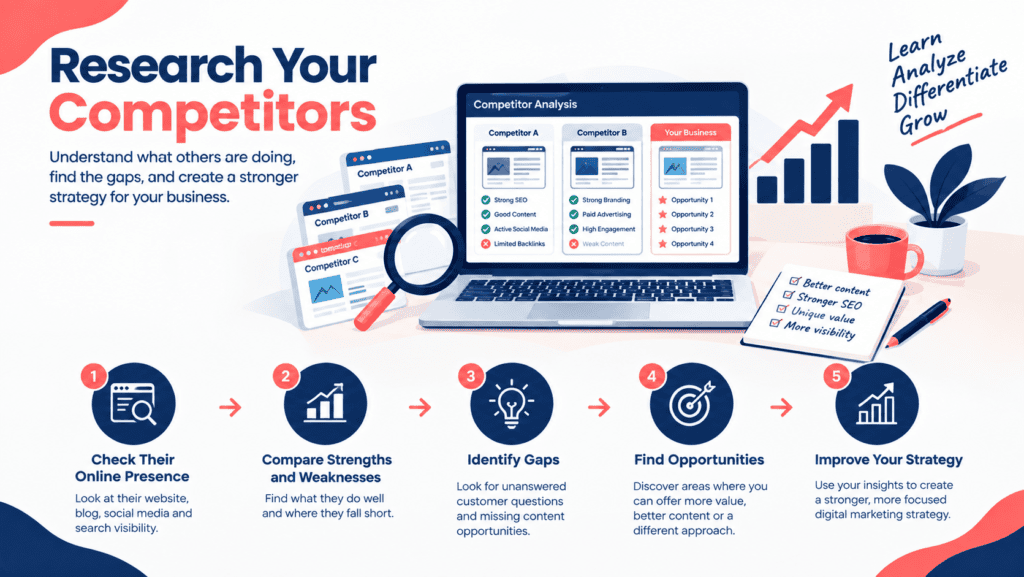
Competitor research can help you identify opportunities.
Look at:
You don’t need to copy what competitors are doing.
Instead, ask:
What are they doing well?
Where are they missing opportunities?
What questions are they not answering?
How can my business provide more useful information?
These insights can help you develop a strategy that differentiates your business.
A common mistake is trying to do everything at once.
A better strategy is to determine which activities are most relevant to your goals and audience.
Consider:
For example, a new business may need to focus on building awareness and credibility, while an established business may need to focus more heavily on generating qualified leads and improving conversions.
Your strategy should be based on business needs, not simply on what’s trending.
Content should support your overall strategy.
Instead of publishing content simply to have something new on your website, create content that answers your audience’s questions.
You can organize content around different stages of the customer journey.
Awareness
Consideration
Decision
This creates a content system that supports customers throughout their journey.
A strong digital marketing strategy gives your business direction, but the next step is turning that strategy into an actionable plan. A digital marketing plan helps you organize your activities, establish a realistic timeline, prioritize your actions, and determine how you will measure progress. If you want to learn how to turn your strategy into an actionable roadmap, read our guide on [How to Build a Digital Marketing Plan: Steps, Timeline & KPIs].
Once you have established:
you need to turn those decisions into specific actions, want to know about how to plan digital marketing.
This is the difference between a strategy and a plan.
Strategy answers :
Plan answers:
“What exactly are we going to do, when will we do it, and how will we measure it?”
A strategy should have measurable outcomes.
Depending on your goals, you might track:
Don’t focus only on metrics that look impressive.
For example, thousands of website visitors aren’t necessarily valuable if none of them become potential customers.
Choose KPIs that connect directly to your business objectives.
Digital marketing is constantly changing.
Your customers, competitors, search behavior, technology, and online platforms can all change over time.
That’s why your strategy shouldn’t remain unchanged forever.
Use a continuous process:
Analyze → Plan → Execute → Measure → Improve
Regularly ask:
This allows your digital marketing strategy to evolve as your business grows.
Choosing the right digital marketing channels is an important part of building an effective digital marketing strategy. Every business does not need to use every online platform. The best channels depend on your target audience, business goals, industry, budget, and the type of content your customers prefer.
Start by identifying where your potential customers spend their time online. For example, search engines can be valuable for businesses that want to attract people who are actively looking for products, services, or information. Social media can help businesses build awareness, engage with their audience, and develop stronger relationships with potential customers. Email marketing can be useful for nurturing leads and maintaining relationships with existing customers.
Your website should remain an important part of your digital marketing strategy because it provides a central place where visitors can learn about your business, explore your content, and take action. Instead of spreading your efforts across too many platforms, focus on the channels that are most relevant to your audience and business objectives.
Once you select your channels, define the purpose of each one. For example, SEO may focus on increasing organic traffic, social media may focus on engagement and brand awareness, and email marketing may focus on nurturing leads. Having a clear purpose for each channel makes your digital marketing strategy more focused and easier to measure.
Your website plays a central role in a successful digital marketing strategy. Even if your business attracts visitors through SEO, social media, advertising, or other channels, those visitors need a website that is easy to use and provides the information they are looking for.
Start by making sure your website is easy to navigate. Visitors should be able to quickly understand what your business offers and find important information without confusion. Clear menus, readable content, descriptive headings, and simple navigation can improve the overall user experience.
Website performance is also important. Slow-loading pages can create a poor experience and may cause visitors to leave before they interact with your content. Make sure images are optimized, unnecessary elements are reduced, and your website works properly on mobile devices.
Search engine optimization should also be part of your website strategy. Use relevant keywords naturally in your page titles, headings, content, URLs, image alt text, and meta descriptions. Create useful content that answers the questions your audience is searching for rather than writing content only for search engines.
Your calls to action should also be clear. Depending on your business goals, you might encourage visitors to contact you, request a consultation, download a resource, subscribe to an email list, or make a purchase.
A well-optimized website helps connect different parts of your digital marketing strategy. Your SEO, content, social media, and advertising efforts can all bring visitors to your website, where they can move closer to becoming leads or customers.
Search engine optimization should be an important component of your digital marketing strategy because it can help your business attract people who are already searching for information, products, or services related to your business.
Begin with keyword research to understand what your target audience searches for online. Look for keywords that are relevant to your products, services, industry, and customer problems. Instead of focusing only on highly competitive keywords, include specific long-tail keywords that closely match your audience’s search intent.
On-page SEO is another important part of the process. Optimize page titles, headings, meta descriptions, URLs, internal links, images, and website content. Your content should clearly communicate the topic of each page while providing genuine value to readers.
Technical SEO should also be considered. Make sure search engines can crawl and index your website properly. Check your website’s mobile usability, page speed, broken links, redirects, and other technical elements that can affect the user experience and search visibility.
Content and SEO should work together. Create helpful blog posts, guides, landing pages, and other resources that answer the questions your potential customers have. For example, a business targeting customers interested in digital marketing could create content around digital marketing strategy, SEO, content marketing, social media, and online business growth.
SEO is not normally an overnight process. It requires consistent publishing, optimization, monitoring, and improvement. By making SEO a long-term part of your digital marketing strategy, you can work toward stronger organic visibility and a steady source of relevant website traffic.
Getting website visitors is only one part of business growth. Your digital marketing strategy should also explain how you will turn interested visitors into leads and, eventually, customers.
Start by identifying the actions you want visitors to take. Depending on your business model, this could include filling out a contact form, requesting a quote, booking a consultation, signing up for a newsletter, downloading a guide, or purchasing a product.
Create clear calls to action throughout your website and content. Instead of using generic messages, make your calls to action relevant to the visitor’s needs. For example, a service-based business could use phrases such as “Request a Consultation” or “Get a Free Quote.”
Landing pages can also support your conversion strategy. A focused landing page should explain the value of your offer, address the visitor’s needs, provide useful information, and make the next step clear. Avoid adding unnecessary distractions that could prevent visitors from taking action.
Lead nurturing is another important part of conversion. Not every visitor will be ready to purchase immediately. Some people may need additional information before making a decision. Email marketing, educational content, case studies, and follow-up communication can help maintain the relationship while the potential customer moves through the buying journey.
Your conversion strategy should also be measured. Track metrics such as form submissions, consultation requests, email sign-ups, sales, and conversion rates. This information can show which parts of your digital marketing strategy are producing results and where improvements are needed.
Consistency is another important element of a successful digital marketing strategy. Your business may communicate with customers through your website, search engines, social media, email, online advertising, and other platforms. Your audience should be able to recognize your business across these different channels.
Start by creating a consistent visual identity. Your logo, colors, fonts, images, and overall design should have a similar appearance across your website and social media profiles. This can make your business appear more professional and recognizable.
Your messaging should also remain consistent. Clearly communicate what your business offers, who it helps, and what makes your business different. Your website, social media posts, advertisements, and email campaigns should support the same overall brand message while adapting the format to each platform.
Consistency does not mean publishing exactly the same content everywhere. Each platform has different user expectations. A detailed blog post can educate your audience, while a short social media post can attract attention and encourage engagement. The core message can remain consistent while the content format changes.
Building a consistent online presence can also help establish trust. When customers repeatedly see useful and relevant information from the same business, they may become more familiar with the brand.
As part of your digital marketing strategy, regularly review your online profiles and make sure your business information is accurate. Update outdated information, check links, refresh important content, and ensure that customers can easily find ways to contact your business.
A digital marketing strategy should not remain unchanged after it is created. Customer behavior, search trends, competitors, technology, and digital platforms continue to change. This means businesses need to regularly review their performance and make improvements based on real data.
Start by reviewing the KPIs you established earlier in your strategy. Look at important performance indicators such as website traffic, organic search visibility, engagement, leads, conversion rates, customer acquisition costs, and revenue. These metrics can help you understand whether your marketing activities are contributing to your business goals.
Testing different approaches can also improve your results. You can experiment with different headlines, calls to action, landing page layouts, content formats, advertising messages, or email subject lines. Compare the results and identify which approaches perform better.
Your analytics data can help you understand customer behavior. For example, if a page receives significant traffic but very few conversions, the content may be attracting the right audience but failing to encourage them to take action. You could improve the page by making the offer clearer, strengthening the call to action, or addressing common customer concerns.
You should also regularly review your competitors and industry trends. A strategy that worked several months ago may need to be adjusted as your market changes. Look for new opportunities, emerging topics, changes in customer preferences, and new ways to reach your audience.
Continuous improvement is what turns a basic marketing plan into a stronger long-term digital marketing strategy. Instead of making major changes based on assumptions, use performance data to identify what is working, what is not working, and what needs to be tested next.
The goal is not to create a perfect strategy from the beginning. The goal is to create a flexible strategy that can learn from results and improve over time. By consistently testing, measuring, and optimizing your activities, you can make your digital marketing efforts more efficient and better aligned with your business growth objectives.
Once your business positioning is clear, the next step is to develop a consistent message across your digital presence.
A customer might discover your business through a search result, read one of your blog articles, visit your website, and later see your social media content. If every interaction communicates something completely different, it can become difficult for the customer to understand what your business actually offers.
A strong digital marketing strategy connects these different touchpoints through a consistent message.
Your website, content, social media communication, and other digital channels don’t need to use exactly the same words, but they should communicate the same core value. This consistency can make your business easier to understand and help create a stronger overall brand presence.
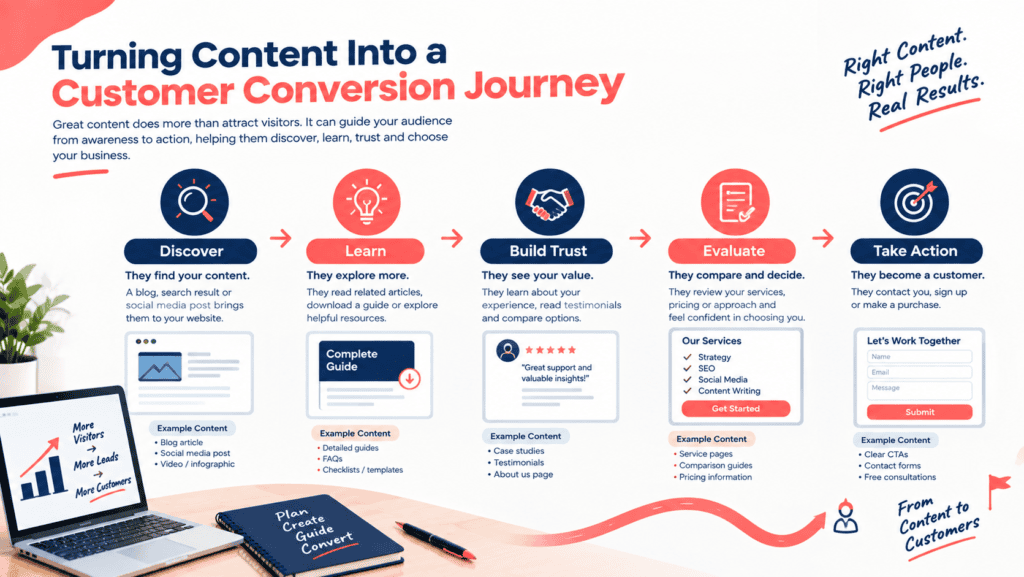
Content should do more than attract visitors to your website. It can also help move potential customers from learning about a problem to considering a solution and eventually taking action.
For example, a person may first discover an educational article while researching a problem. After reading it, they may want more detailed information, which can lead them to another related article or guide. From there, they may visit a relevant website page and eventually contact the business.
This creates a connected journey:
Discover → Learn → Explore → Evaluate → Act
A good digital marketing strategy considers what should happen at each stage rather than treating every piece of content as an isolated publication.
This is particularly important for your website because your blog content can guide visitors toward other relevant pages and resources.
Trying to reach everyone
A strategy becomes less effective when the target audience is too broad.
Focusing only on traffic
Traffic is useful, but qualified traffic and conversions are often more important.
Following every marketing trend
Not every trend is relevant to every business.
Ignoring the customer journey
Customers need different information at different stages of their decision-making process.
Not connecting marketing with business goals
Marketing activities should contribute to measurable business objectives.
Creating a strategy but not a plan
A strategy provides direction, but you need a structured plan to turn that direction into action.
This distinction is particularly useful for your two cluster articles.
| Digital Marketing Strategy | Digital Marketing Plan |
|---|---|
| Defines the overall direction | Defines specific actions |
| Focuses on what and why | Focuses on how, when, and what next |
| Identifies goals and audience | Organizes activities and timelines |
| Defines priorities | Assigns tasks and resources |
| Provides the framework | Turns the framework into action |
| Long-term direction | Practical execution |
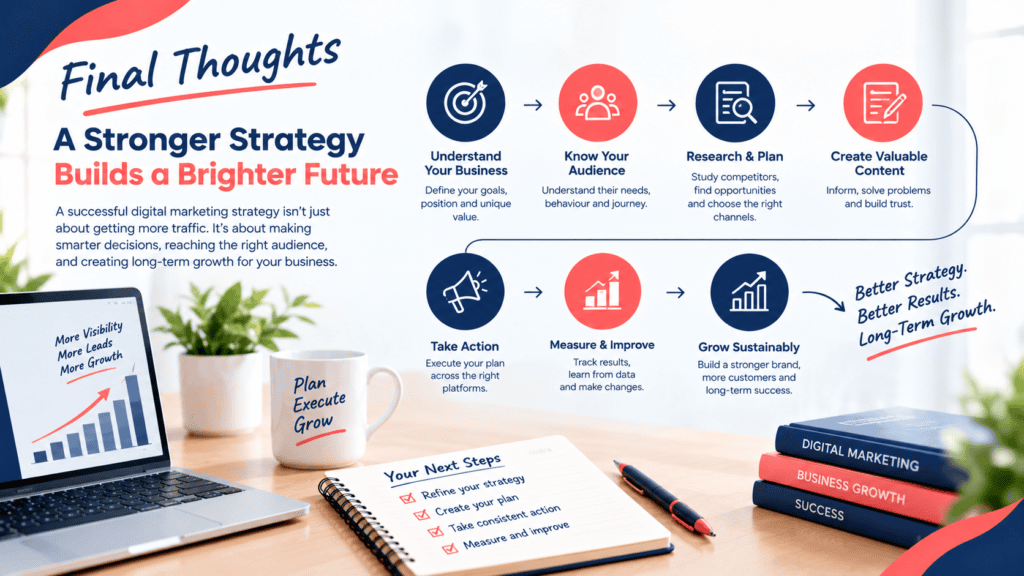
A strong digital marketing strategy for business growth starts with understanding the business, its goals, its customers, and its competitive environment.
From there, businesses can establish their priorities, understand the customer journey, create relevant content, and determine how success will be measured.
But strategy is only the beginning.
Once you know where you want to go and why, you need to determine what you will actually do to get there.
That’s where your digital marketing plan comes in.
© 2026 R Disha. All Right Reserved.
Ready to get started? Chat with us on WhatsApp!